
What to expect at an improv show in Tokyo, in one paragraph
A first improv show asks very little of you. Wear what you like, arrive when doors open to order food, sit wherever you want to see from, and laugh as loudly as you feel like. The fear most first-timers bring, being singled out, does not apply at Pirates of Tokyo Bay: nobody goes on stage unless they volunteer, and you can say no. English and Japanese improv comedy. Unscripted, unpredictable. At What the Dickens! in Ebisu, one Sunday a month.
Quick Facts
When: one Sunday a month, January to November (no December show). Doors 7:00pm, show 7:30pm. About 2 hours including a 15-minute break.
Where: What the Dickens!, a British pub on the 4th floor of Roob 6 Building, 1-13-3 Ebisunishi. A 3-minute walk from JR Ebisu Station West Exit, 1 stop from Shibuya on the Yamanote Line.
Price: ¥2,500 with your 1st drink free. Early-purchase pair ¥4,400 until one week before the show.
What it is: English and Japanese improv comedy. Everything is made up on the spot from audience suggestions. Nobody goes on stage unless they volunteer.
Food: full pub menu during the show (fish & chips, meat pies, burgers, draft beer, cider, cocktails). Indoors, rain or shine.
Reputation: Google rating 4.9 from 200+ reviews. Winner of the Peatix Community Award 2026 (Creative Arts Community).
Can a first-timer enjoy a live comedy show?
Yes, and improv is one of the easiest kinds to start with, because nobody in the room has seen the material before, including the cast. There is nothing to be behind on. The show is built from suggestions shouted by the audience, and the first few minutes exist to get the room comfortable doing that.
At one show, the warm-up was a single question: tea or coffee? Mike asked the room to shout its answer. Hiromi, translating, first asked the Japanese speakers to raise a hand, which is the culturally sensible version, then rewrote the rules on the spot so they could shout too. On three, the room erupted, heavily in favour of coffee. That is the entire skill set required of an audience: have an opinion, and say it out loud if you want to.
Half the show is in English and half in Japanese, with games in gibberish that need no language at all, so you do not need both languages, or either one perfectly. Phones on silent, please do not record or film the show, and laugh as loudly as you like; laughter is the fuel. If you are still choosing which kind of comedy to try first, the live comedy guide compares the options.

Will I get pulled on stage, and can I say no?
Nobody goes on stage unless they volunteer, and a volunteer means a volunteer: if your hand stays down, the game goes on without you, and nobody minds.
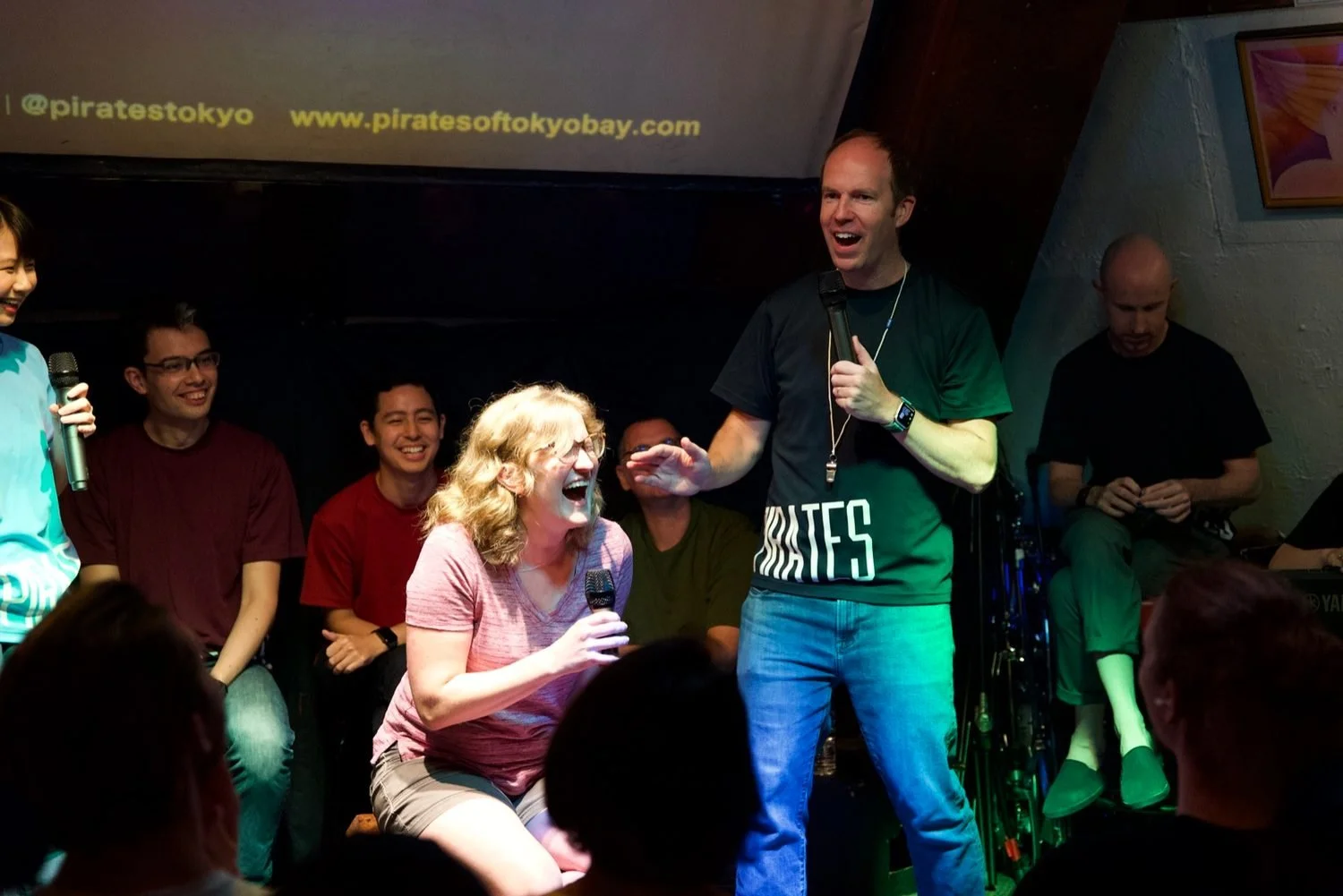
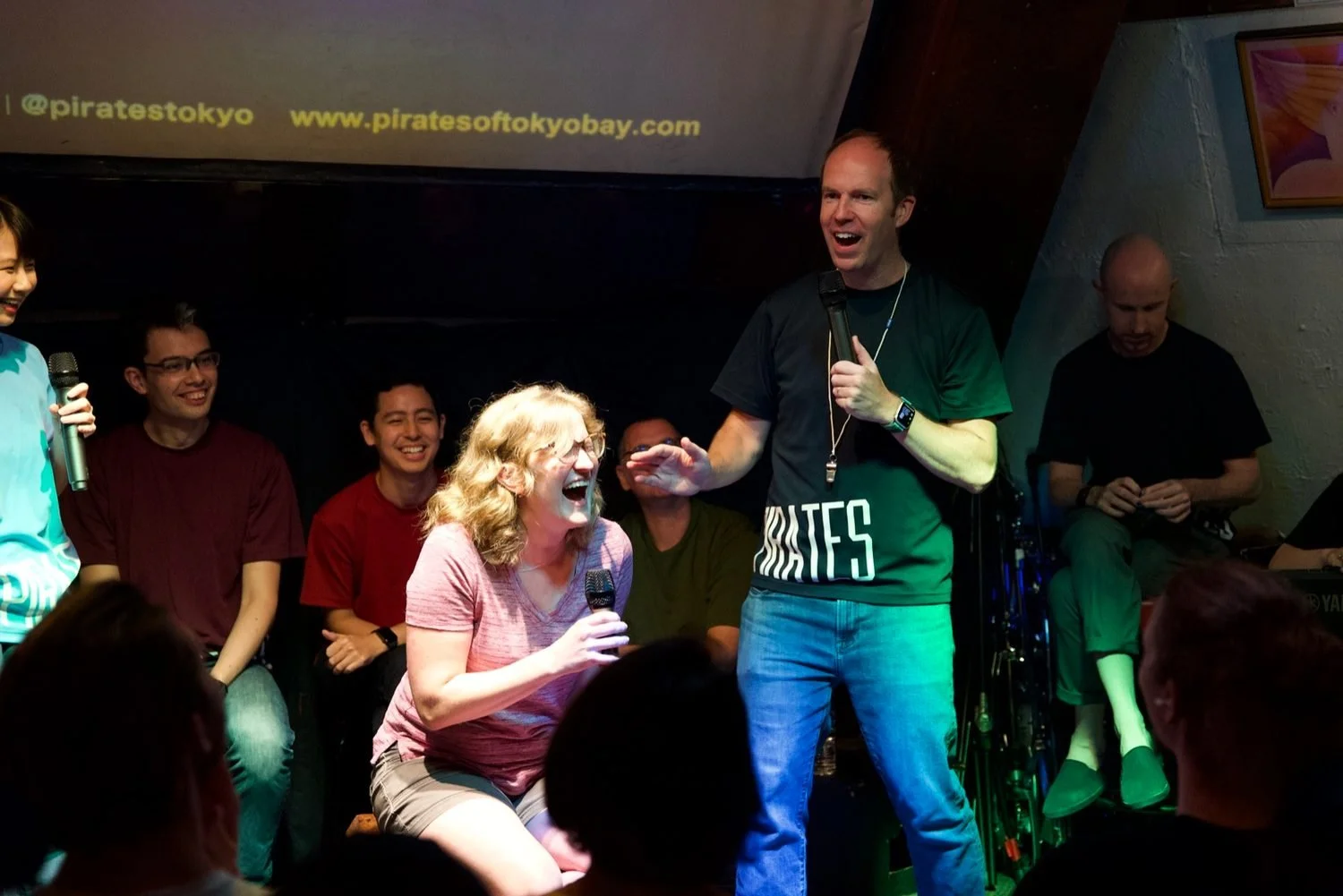
When MC Trey asked for one at that same show, a hand shot up immediately. Asked whether the interview should be in English or Japanese, the volunteer chose English. Asked her name, she said "Yui desu", and Trey, in true improv form, ran with it: "Okay, this is Yuides." She laughed and explained that she had introduced herself the Japanese way, and the whole room laughed along with her. That is what volunteering looks like: the performers do the work, and anything that goes wrong is material.
What does an audience participation show in Tokyo actually look like?
Mostly, the audience shouts short suggestions and the cast turns them into scenes. A suggestion can be as simple as a place you would take a first date.
In one gibberish game that night, Mike had to guess a new household chore his teammates acted out without real words. Rodger, speaking what can only be described as the language of an exceptionally helpful martian, did a small hula, patted a tree, and climbed up and down it. Mike guessed coconut. Rodger climbed back up and stroked the palm fronds. Then stroked them again. Eventually the chore landed: instead of scooping the cat's litter box, Mike was cleaning a palm tree with a cowboy hat, for his pet bulldozer.
Nobody in the room needed a language to follow it. That is what the gibberish games are for, and it is why an audience participation show in Tokyo can work for a table of Japanese speakers and a table of visitors at the same moment.
What should I wear?
Anything. There is no dress code at a comedy show, and What the Dickens! is a British pub, so weekend clothes are exactly right. The only three things worth avoiding at any live show: a hat tall enough to block the row behind you, jewellery that jingles, and strong perfume. You will be eating while you watch, so perhaps not the white shirt.
When should I arrive?
Doors open at 7:00pm and the show starts at 7:30pm. Arriving at doors gives you half an hour to settle in and order food and drinks at the bar, so you are eating when the show begins rather than queuing.
Where should I sit?
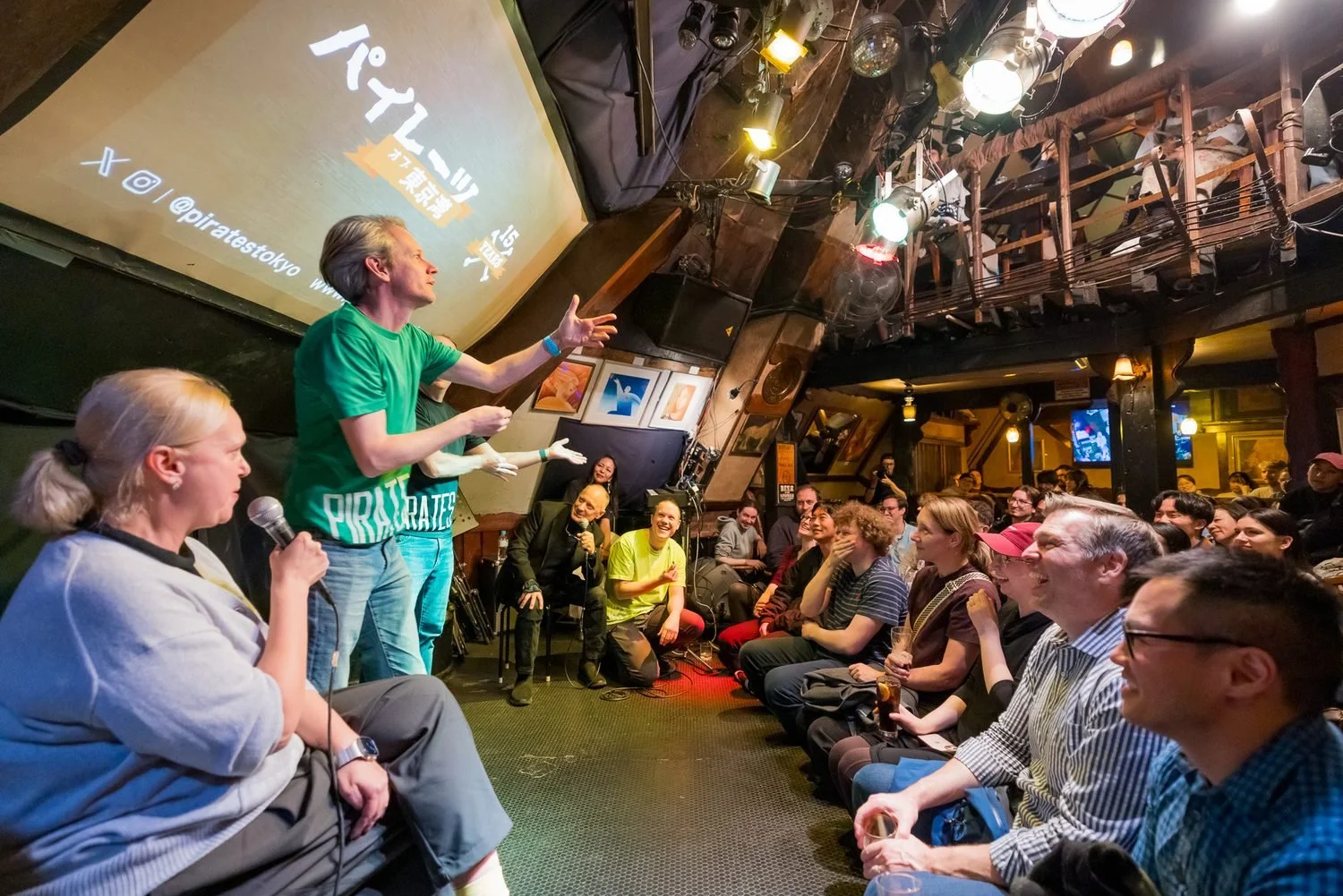
Wherever you want to see from. The front is close enough to catch every face; the back and sides make trips to the bar easier. At a stand-up show, the front row is where the comedian goes looking for someone to talk to. At an improv show, suggestions come from everywhere in the room, so taking part barely depends on your seat, and wherever you sit, nobody is taken on stage without volunteering.
How is an improv show different from a comedian's live?
A stand-up or sketch show is material the performer wrote and rehearsed. An improv show has no script and is made from audience suggestions on the spot, so no two shows are the same. The improv versus stand-up explainer covers the rest.
Is going alone normal?
Yes. Comedy is one of the easiest things to see alone: the lights go down, everyone faces the same way, and nobody checks who came with whom. Solo audience members are a normal part of the room in Ebisu. Get a drink, find a seat, laugh, go home; nobody expects you to talk to anyone. The rest of the usual hesitations are answered on the FAQ page.
Show details
Next show: Thanksgiving Comedy, Sunday, November 29
Venue: What the Dickens!, Ebisu. 4th floor of Roob 6 Building, 1-13-3 Ebisunishi. A 3-minute walk from JR Ebisu Station West Exit, 1 stop from Shibuya
Time: doors 7:00pm, show 7:30pm. About 2 hours including a 15-minute break
Price: ¥2,500 with your 1st drink free. Early-purchase pair ¥4,400 until one week before the show
The front row at a comedy show is usually the nervous seat. Here it is just the one with the best view of the martian.